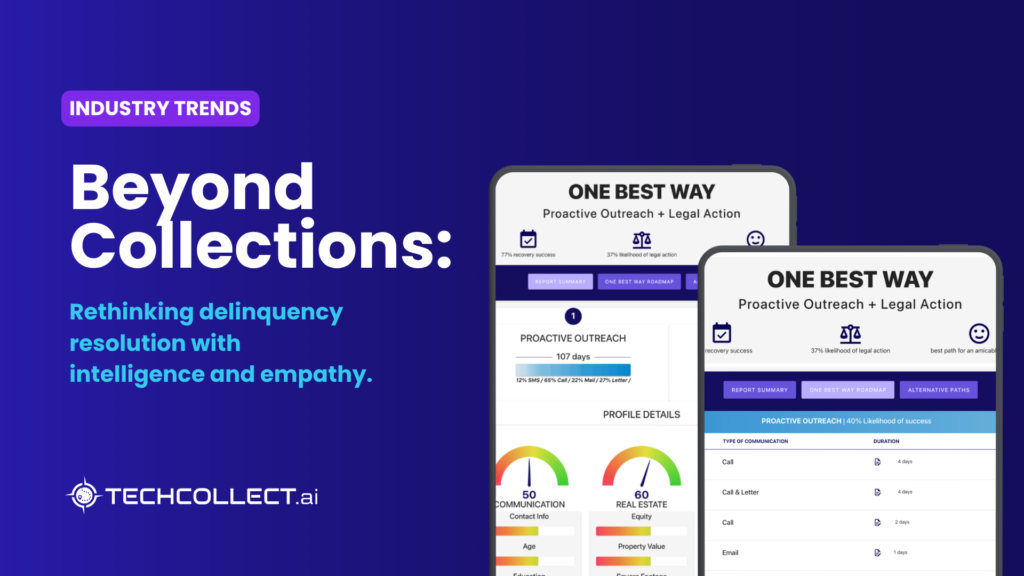
At CINC Up 2026, we took the stage for “Beyond Collections: Rethinking Delinquency Resolution with Intelligence and Empathy” to talk about a problem that is becoming harder for community association management companies to ignore: the traditional collections model starts too late.
For years, the process has been relatively predictable. An assessment comes due, a homeowner misses a payment, notices are sent, the balance continues to age, and eventually the account moves to an attorney, lien, or even foreclosure. But by the time an account reaches legal collections, the balance is larger, the homeowner is more frustrated, the management team has already invested significant time into the account, and the association has fewer options available to resolve it. The central message of our CINC Up session was that the industry has an opportunity to intervene much earlier, and increasingly, both financial realities and regulatory changes are making that shift necessary.
The pressure is growing on associations and homeowners
Community associations are being squeezed from multiple directions. Insurance, labor, utilities, materials, repairs, reserve requirements and years of deferred maintenance are all placing more pressure on association budgets. 93% of community associations reported higher property and casualty premiums at their most recent renewal. At the same time, homeowners are absorbing higher assessments, special assessments, insurance and property tax increases, and the same cost-of-living pressures affecting households across the country.
The result is showing up in delinquency data. HOA-related foreclosure filings increased nearly 40% over a two-year period, with 6,376 properties facing HOA-related foreclosure filings during the first quarter of 2026 and more than 285,000 association liens filed during 2025. We recently explored those trends in more detail in There’s Been a 40% Jump in HOA Foreclosures. Now What?.
Those numbers are alarming, but foreclosure isn’t where the problem begins. It begins months earlier, when an assessment first becomes past due. That is also where management companies have the greatest opportunity to change the outcome.
The same balance does not always mean the same problem
One of the examples we shared at CINC Up involved four homeowners who each owed $1,200. One had changed banks and forgotten to update autopay. Another couldn’t understand the notices being sent. Another had recently lost a job. The fourth was dealing with an extended hospitalization.
On an aging report, those four accounts may look nearly identical. In reality, they represent four very different situations.
The traditional collections model tends to respond primarily to the balance and the amount of time it has been outstanding: balance → letter → letter → attorney. A more intelligent pre-collections model can look at the balance alongside account history, prior communication, timing, homeowner response, governing policy and communication channels to determine the next best action for an account.
That doesn’t mean ignoring collection policies or applying rules inconsistently. It means using more information to determine how to move an account toward resolution while it is still relatively manageable. TechCollect was built around that idea: helping management companies create an intelligent pre-collections layer before accounts need to move into traditional legal collections.
Regulation is pushing the industry upstream, too
The shift toward earlier intervention isn’t happening only because it produces a better homeowner experience. Legislatures across the country are increasingly focusing on what associations must do before an account can move toward legal action.
Our CINC Up session reviewed changes and existing requirements across states including Washington, California, Nevada, Arizona, Colorado, Texas, Minnesota, Illinois, Georgia, Florida and Maryland. The details vary significantly, but the broader direction is remarkably consistent: more notice, more time, more options and later escalation.
Georgia, for example, recently adopted changes that introduce longer notice periods and new requirements affecting the collections process beginning in 2027. We break those changes down in Georgia’s New HOA Law Is Changing More Than Foreclosures. Florida associations already operate under detailed notice requirements, including the Notice of Late Assessment process, which we cover in our guide to Florida NOLA requirements.
For management companies operating across multiple jurisdictions, collections are therefore becoming as much a workflow and compliance challenge as a financial one. The question can no longer simply be, “When does this account go to the attorney?” Management teams also need to understand what must happen between the first missed payment and attorney turnover, and have a reliable way to make sure it actually happens.
Earlier doesn’t mean harsher
There can be a tendency to equate earlier collections activity with more aggressive collections. In practice, earlier engagement can create the exact opposite experience.
When communication starts while the balance is still relatively small, there are fewer accumulated fees, more potential paths to resolution and more time to address questions or problems before an attorney becomes necessary. Homeowners are less likely to be surprised by a large balance, managers encounter fewer escalations, and boards aren’t pulled into as many difficult situations.
That is where empathy becomes operational rather than simply emotional. An empathetic process means communicating in clear language, reaching homeowners at an appropriate time, using channels they are likely to respond to, making balances transparent, supporting language accessibility, providing an easy way to respond and consistently following up. It also means knowing when automation should continue the process and when a human being should step in.
Technology should not eliminate judgment. It should eliminate enough repetitive work that management teams have more time to use judgment where it matters.
Every escalation has a cost
A past-due balance can create far more work than a line on an aging report suggests. Someone may need to check the ledger, review prior communication, send an email, answer a homeowner’s response, explain the balance, review association policy, send another notice, document everything, update the board and eventually prepare the account for attorney turnover.
Multiply that process across hundreds or thousands of accounts and a collections problem quickly becomes an operational capacity problem.
Legal escalation creates additional costs as well: attorney fees, administrative expenses, certified mail, board involvement, homeowner frustration, complaints, compliance exposure, reputational impact and longer recovery cycles. Legal action will always have an appropriate place in the process for accounts that cannot otherwise be resolved, but it should not have to compensate for the absence of an effective process before legal action.
That is why we introduced the Resolution Flywheel during our CINC Up session. Rather than thinking about delinquency as a straight line toward collections, the model starts by identifying the problem early, understanding its context and applicable legal requirements, choosing the next best action, communicating, measuring the homeowner’s response, adapting based on that response and then either resolving or escalating the account. Each step creates information that improves the next decision.
What happens when we move upstream?
The numbers shared at CINC Up demonstrate the potential impact of that change. TechCollect’s pre-collections approach has produced 2.4x faster recovery of past-due assessments and a 90%+ reduction in legal expenses in the results presented during the session. We also shared the experience of RowCal, which achieved 95% resolution of delinquent accounts within 120 days, with 87% resolved within the first 60 days. After automating hundreds of homeowner communications through TechCollect, the organization experienced a 20.2% increase in resolved units in one week.
The important point isn’t simply that technology can send more communications. Sending the same collection letter faster isn’t transformation. The opportunity is to use automation and intelligence to resolve more accounts before traditional collections become necessary.
Going beyond collections
Delinquencies aren’t disappearing, and neither are the financial pressures facing associations and homeowners. Meanwhile, states are increasing scrutiny of how associations communicate with homeowners and what must occur before an account can escalate.
That makes the old model — wait, send notices, wait some more, then turn the account over to legal — increasingly difficult to justify operationally or financially.
Going beyond collections means moving upstream. It means identifying delinquency earlier, understanding the context surrounding an account, communicating consistently, creating more opportunities for resolution, automating repetitive administrative work and reserving legal escalation for the accounts that actually require it.
Because the future of association collections isn’t about becoming more efficient at sending homeowners to collections. It’s about building a better process so fewer homeowners need to get there in the first place.
Want to see what that could look like across your portfolio? Explore TechCollect or start a free TechCollect trial to see how pre-collections can fit into the workflows your team already uses.